Author: Christine Yount Jones

  • Welcome to the Messiness of Writing

    Welcome to the Messiness of Writing

    I read something the other day about writing that said to create a beautiful place to write. And I thought of all the ideas I have had in the past for a perfect writing area: a tasteful color scheme, flowering plants, a reading chair and lamp straight from the boards of Pinterest, no dust, no clutter, a window to the world that would make me wax poetic. And then I thought of other writers’ advice about writing spaces.

    Stephen King in his book On Writing said he started writing in his laundry room—a noisy, distracting place—in a double wide trailer. He said that the only thing that was important about his writing space was a closed door.

    I wrote my first two published novels, Carrie and ’Salem’s Lot, in the laundry room of a doublewide trailer, pounding away on my wife’s portable Olivetti typewriter and balancing a child’s desk on my thighs; John Cheever reputedly wrote in the basement of his Park Avenue apartment building, near the furnace. The space can be humble (probably should be, as I think I have already suggested), and it really needs only one thing: a door which you are willing to shut. The closed door is your way of telling the world and yourself that you mean business; you have made a serious commitment to write and intend to walk the walk as well as talk the talk. Stephen King, On Writing, p. 144

    Foster and Small Things Like These author Claire Keegan, when asked at a recent writing retreat about her writing room, pierced our romantic images of her writing with a view to the green pastures of Ireland, her beloved horses frolicking near the sheep of a thousand hills. Instead, she said she had blocked off the window with a giant PC screen to do her work. So she could focus. So she could do the hard work of writing.

    Trying to create the “perfect” space for writing is a distraction from the writing. It can actually be a metaphor for the writing itself as that search for perfection bleeds into the way we write.

    Anne Lamott in Bird by Bird writes :

    “Perfectionism means that you try desperately not to leave so much mess to clean up. But clutter and mess show us that life is being lived. Clutter is wonderfully fertile ground—you can still discover new treasures under all those piles, clean things up, edit things out, fix things, get a grip. Tidiness suggests that something is as good as it’s going to get. Tidiness makes me think of held breath, of suspended animation, while writing needs to breathe and move.” Anne Lamott, Bird by Bird, p. 28

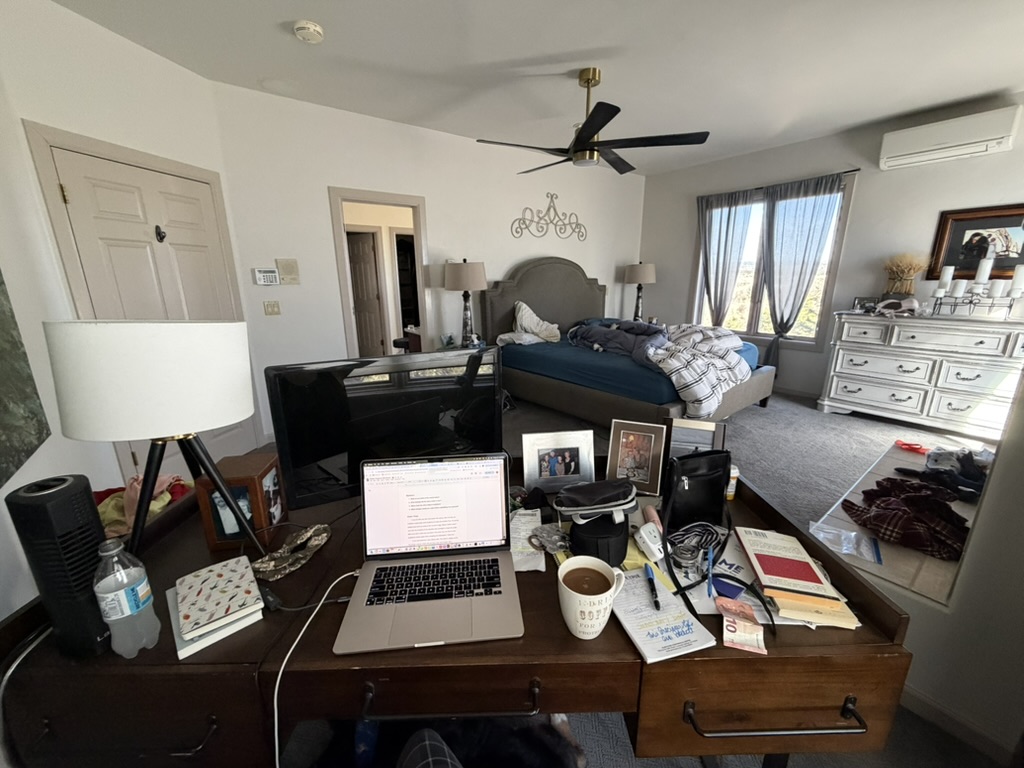
    So where do I write? In a corner of my bedroom, facing an unmade bed, on a desk with clutter and chaos that only I understand. It’s a place where I can shut the door, turn on the fan, close the blinds so the sun doesn’t hurt my eyes. It has photos of the people I love and miss, along with things I should put away but doing so would distract me from the work.

    I also write on planes and in airports. I write in a recliner in my living room. I write on my laptop and on my phone. The issue isn’t really where I write; it’s to just write. Just do the work.

    The writer of Ecclesiastes understood the enemy of perfection when he wrote:

    “If you wait for perfect conditions, you will never get anything done.” Ecclesiastes 11:4

    There’s no such thing as a perfect writing environment so let’s stop waiting for it and just write!

  • Someone, the Champlain Towers South

    Someone, the Champlain Towers South

    With the tragedy in Surfside, I could not stop thinking of the word “someone.” So many someones who were lost. I thought of how these people were doing normal things all day long that day and as I read the tributes to those who have been discovered and are still missing, I pooled the things that were said about these dear people to write this essay. 

    On the day before the building came crashing down with hell’s fury in the deep of night, it was a day like any other–a day someone did what someone does when mercifully unaware that someone’s end is near.

    Someone talked to friends. Cassie Billedeau-Stratton talked to her husband from the fourth floor. Michael Altman talked to his son. Anastasia Gromova talked to her mother. “I love you,” she told her. Someone talked to a brother, a sister, an uncle the day before the building came crashing down. 

    Someone watched the sunset on the watery horizon and sighed a prayer to God. Magaly Elena Delgado gazed at the ocean she had dreamed of living near, breathing in its salty air for the last time. 

    Someone played cards. Someone shopped online. Someone finished a book while someone else started one. Someone wrote a letter. 

    Someone read the Torah. Someone read the Bible. Someone read the Koran. Hilda Noriega clutched the Rosary as the building came crashing down.

    Someone cooked Ropa Vieja, someone ate Gallo Pinto, and someone swallowed the last spoonful of Sopa Paraguaya. Someone fed their children Dulce de Leche and someone braided an exquisite Challah loaf as she had so many times before. 

    A world of smells wafted from kitchens the day before the building came crashing down.  

    Someone was the world to her family. 

    Someone helped a neighbor. Someone said good morning and someone said good night. Antonio and Gladys Lozano had dinner with their son and kissed him goodbye, not knowing it would be their last before the building came crashing down.

    Someone teased his wife. Someone argued. Someone made up. Someone hugged his loved ones tightly. Someone made love. 

    Someone paid bills while someone fried an egg. Someone folded laundry. Someone shined the windows that would shatter into a million pieces when the building came crashing down.

    Someone waited for test results. Someone hoped for a miracle. Ilan Naibryf and Deborah Berezdivin attended a friend’s funeral the day before the building came crashing down. 

    Someone watched her wedding video. Ruslan Manashirov and Nicole Doran-Manashirov wrote thank you notes that would never be sent. Gladys and Antonio Lozano planned their 59th anniversary party. Someone longed for her late husband the day before the building came crashing down.

    Someone beamed with pride because of her children, her grandchildren, her great-grandchildren. Judy Spiegel ordered a dress for her granddaughter while someone looked forward to his first grandchild. 

    Someone rocked a baby, inhaling the sweet smell of freshly washed hair. Aishani Gia Patel crawled across a solid floor that would disappear beneath her. Her parents chose a name for their unborn baby for a lifetime that was not to be. Someone kissed a child goodnight the day before the building came crashing down.

    Now I lay me down to sleep, I pray the Lord my soul to keep; If I should die before I ‘wake, I pray the Lord my soul to take.

    Someone slept soundly. Someone tossed and turned. 

    Someone heard creaking noises the day before the building came crashing down.

    Someone felt the building sway.

    Someone saw a crack opening up.

    Someone felt the wind.

    Someone–


    Sources: https://www.local10.com/news/local/2021/06/28/stories-of-surfside-condo-victims-identified-life-of-the-party/

    https://www.cnn.com/2021/06/24/us/miami-building-collapse-victims-missing/index.html

    https://abcnews.go.com/US/victims-surfside-condo-collapse/story?id=78517075 

  • I Can Twang With the Best of Them

    I Can Twang With the Best of Them

    “You talk funny,” my family complains in their midwestern twang every time I go back to visit them in southern Oklahoma.

    “I have no idea what you’re talking about,” I say with precise diction.

    My siblings and I, having been born in Arizona, learned to speak in a way that follows established phonetic rules. Then when I turned 7, we moved to Oklahoma where people’s syllables seemed to run amok.

    My brothers and sister assimilated this new language, but I somehow kept my crisp mother tongue. Now every time I protest that I do not speak funny, they list the words I say wrong, including my younger brother’s name. 

    “Why can’t you say his name right?”

    “I am saying it right.” 

    I say it several times: Cole, Cole, Cole. 

    Cull, Cull, Cull. They parrot me. 

    Each time, they shake their heads in disgust.

    They brand me a northerner even though I live just a couple states away to the northwest–not straight north. Doesn’t that make me a westerner? And why does it matter, anyway? They are midwesterners–not southerners! 

    Then one afternoon from Colorado while trying to locate an old friend I can’t find on social media, I called the Dunn Lumber Company in my family’s town. I hoped he could give me his sister’s number.

    “Is James Lance there?” I asked the woman who answered. 

    “Who-o-o-o?” she asked in a voice like sweet tea.

    “James Lance.” I emphasized each mono-syllable of his name.

    “Who-o-o?”

    I said it again, but louder. 

    “James. James Lance.”

    “Ma’am, I cannot understand a word you’re saying.” She strung out every syllable.

    “Ja-imz. Ja-imz La-ince,” I drawled out. 

    “Oh, no. He’s not here today.”

    That day, I learned the hard way that I truly no longer speak the dialect of my clan, but I can twang with the best of them when necessary.

    (You can learn more about me here if you’re interested.)