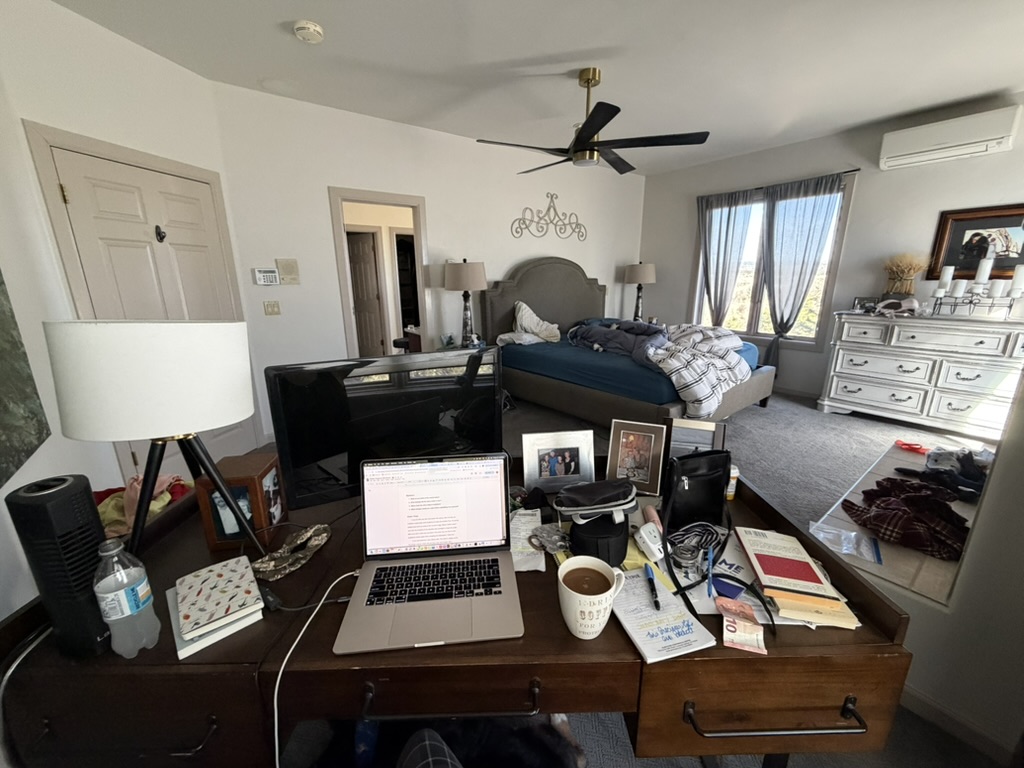
I read something the other day about writing that said to create a beautiful place to write. And I thought of all the ideas I have had in the past for a perfect writing area: a tasteful color scheme, flowering plants, a reading chair and lamp straight from the boards of Pinterest, no dust, no clutter, a window to the world that would make me wax poetic. And then I thought of other writers’ advice about writing spaces.
Stephen King in his book On Writing said he started writing in his laundry room—a noisy, distracting place—in a double wide trailer. He said that the only thing that was important about his writing space was a closed door.
I wrote my first two published novels, Carrie and ’Salem’s Lot, in the laundry room of a doublewide trailer, pounding away on my wife’s portable Olivetti typewriter and balancing a child’s desk on my thighs; John Cheever reputedly wrote in the basement of his Park Avenue apartment building, near the furnace. The space can be humble (probably should be, as I think I have already suggested), and it really needs only one thing: a door which you are willing to shut. The closed door is your way of telling the world and yourself that you mean business; you have made a serious commitment to write and intend to walk the walk as well as talk the talk. Stephen King, On Writing, p. 144
Foster and Small Things Like These author Claire Keegan, when asked at a recent writing retreat about her writing room, pierced our romantic images of her writing with a view to the green pastures of Ireland, her beloved horses frolicking near the sheep of a thousand hills. Instead, she said she had blocked off the window with a giant PC screen to do her work. So she could focus. So she could do the hard work of writing.
Trying to create the “perfect” space for writing is a distraction from the writing. It can actually be a metaphor for the writing itself as that search for perfection bleeds into the way we write.
Anne Lamott in Bird by Bird writes :
“Perfectionism means that you try desperately not to leave so much mess to clean up. But clutter and mess show us that life is being lived. Clutter is wonderfully fertile ground—you can still discover new treasures under all those piles, clean things up, edit things out, fix things, get a grip. Tidiness suggests that something is as good as it’s going to get. Tidiness makes me think of held breath, of suspended animation, while writing needs to breathe and move.” Anne Lamott, Bird by Bird, p. 28
So where do I write? In a corner of my bedroom, facing an unmade bed, on a desk with clutter and chaos that only I understand. It’s a place where I can shut the door, turn on the fan, close the blinds so the sun doesn’t hurt my eyes. It has photos of the people I love and miss, along with things I should put away but doing so would distract me from the work.
I also write on planes and in airports. I write in a recliner in my living room. I write on my laptop and on my phone. The issue isn’t really where I write; it’s to just write. Just do the work.
The writer of Ecclesiastes understood the enemy of perfection when he wrote:
“If you wait for perfect conditions, you will never get anything done.” Ecclesiastes 11:4
There’s no such thing as a perfect writing environment so let’s stop waiting for it and just write!


Leave a Reply